Co-Response Evaluation Toolkit

When someone calls for help during a behavioral health crisis, success looks different from one call to the next. One person may need to be connected to a clinician on scene; another may need a follow-up conversation days later. That range is a strength of Co-Response programs, but it also makes them difficult to evaluate with standard measures.
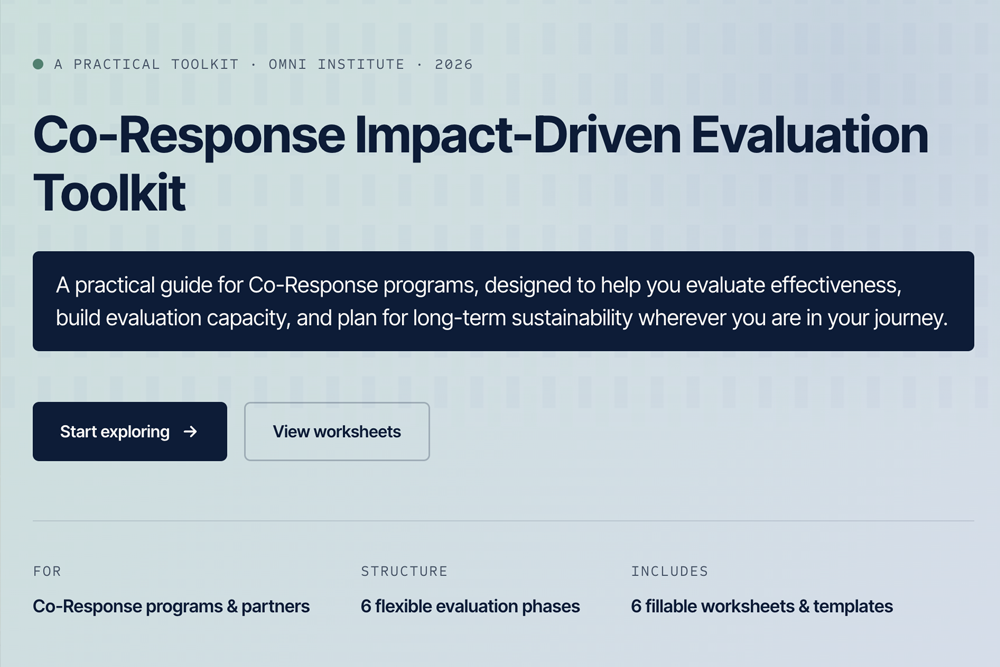
The Co-Response Impact-Driven Evaluation Toolkit addresses that challenge. Drawing on Omni's Co-Response evaluation expertise, it helps programs show their impact, build evaluation capacity in-house, and plan for long-term sustainability.
Why Is Co-Response Hard to Evaluate?
Co-Response programs pair the safety expertise and access of first responders with the clinical skills of behavioral health professionals. The toolkit uses the term broadly to include alternative and community-based crisis response models. Across these models, it names three challenges:
- Success is subjective. Each person using crisis services has different goals, so a single standard measure rarely fits.
- Programs are community-specific. Teams adapt their methods to local needs, which makes consistent tracking across programs difficult.
- There is no universal standard. In the toolkit's words, "There is no single 'best practice.'" Standardization is not always the goal.
The toolkit takes a strengths-based approach to these challenges. Programs start from what they value and measure what reflects it.
Six Phases, From Values to Sustainability
The toolkit moves through six phases, and programs can work through them in order or start wherever they have the most need.
- Identify Values. Write down the guiding principles behind the program's purpose. Community partners and people with lived experience help shape them.
- Choose Relevant Outcomes. Turn those values into measurable short-term, intermediate, and long-term outcomes, using a logic model to connect them. The guidance is plain: resist the urge to measure everything.
- Align Data and Outcomes. Audit what the program already collects. Sort each data point into critical or merely interesting, and check whether current data systems support the team's work.
- Optimize Data Collection. Map where data is collected at each stage of a call (Initial Call, On-Scene, Disposition, and Follow-Up). The phase also covers who enters data, where it is stored, and how information-sharing agreements fit with privacy rules (e.g., HIPAA and 42 CFR Part 2).
- Refine Results and Tell the Story. Check data quality before analysis. Then apply four approachable techniques (cleaning data, counting frequencies, calculating means, and computing percentages), all of which work in Excel or Google Sheets.
- Demonstrate Impact and Sustain. Share findings with different audiences and plan for the future. A SWOT analysis helps teams take stock. The phase also covers four funding strategies: general fund allocations, dedicated tax revenue, local, state, and federal grants, and private philanthropy.
Worksheets That Turn Guidance Into Practice
Each phase comes with a fillable PDF worksheet, so teams can apply the guidance to their own program right away:
- Worksheet 1: Brainstorming Program Values & Goals
- Worksheet 2: Logic Model Template
- Worksheet 3: Implementation Plan Template
- Worksheet 4: Data Collection Workflow
- Worksheet 5: Data Auditing Checklist
- Worksheet 6: SWOT Analysis Practice
Who the Toolkit Is For
The toolkit serves Co-Response and alternative crisis response programs, their partners, and anyone who monitors outcomes for these services. Most of it assumes no specialized software or evaluation training. That lets program staff build evaluation into their daily work without waiting on outside support.
Get our latest findings delivered to your inbox.

Get our latest findings delivered to your inbox.
Get updates on our research findings, projects, and the latest in evidence-based news to improve lives, build better systems, and drive social change.
