The Case for Nonprofit Collaboration in a Lean Funding Era

Published
November 19, 2026
nonprofit-collaboration-lean-funding-era
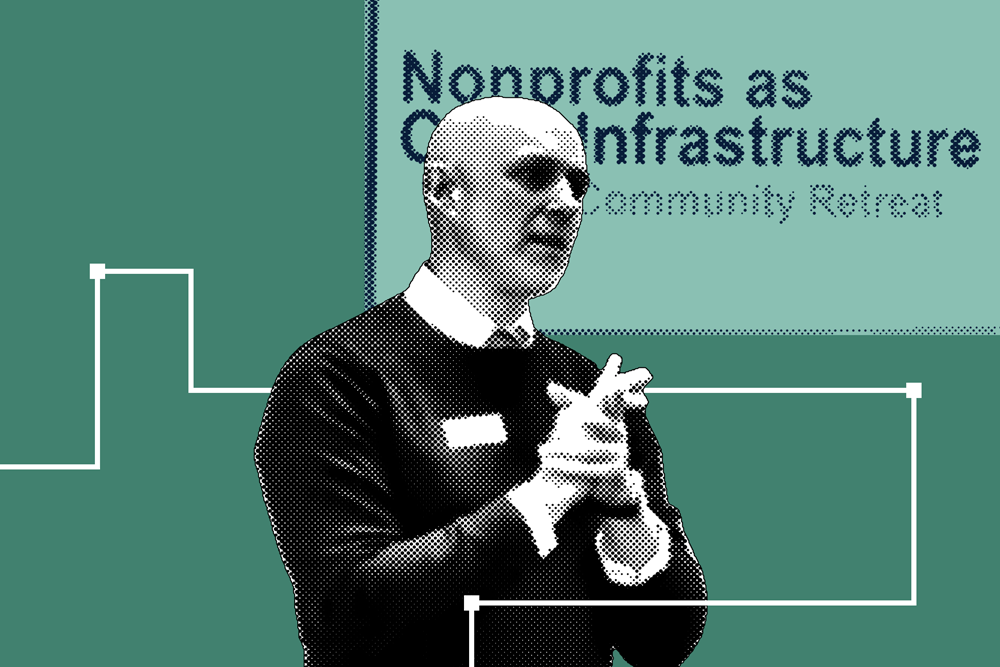
Omni Co-CEO, Aaron Smith, spoke at the Littleton Community Retreat about how nonprofits are vital civic infrastructure, how they are under real strain at a time when political division, economic uncertainty, and online life are already wearing down our civic fabric, and solutions to address these challenges.
Colorado Nonprofit Association research counts more than 34,000 nonprofits in the state of Colorado, generating an estimated $62 billion in annual economic impact and $25 billion in direct GDP. The nonprofit sector employs approximately 182,000 people and supports roughly 80,000 more jobs. Taken together, this is about 10% of the state's private sector workforce. (For comparison, agriculture, mining, and utilities combined employed about 45,000 Coloradans in the first quarter of this year.) Plus, an estimated 1.6 million volunteers add 92.4 million hours of service each year.
Most nonprofits are small businesses, averaging about five staff, and our view of economic conditions deserves the same attention other industries receive. We fill gaps that markets and government leave open, and in many cases our work saves lives.
The most immediate threat is funding, driven by federal decisions that are cascading through the system. Funding by foundations is feeling corresponding strain.
State funding, membership, and event revenue are shrinking too, while policy threats grow and demand for services rises. Planned nonprofit hiring has fallen by half, and burnout among nonprofit CEOs tops 50% in one report.
Pressure like this pushes organizations toward a scarcity mindset of pulling back and protecting what they have. I'd argue this is exactly when we most need to try new things. Two ideas stand out.
The sector's impact is large, yet we remain fragmented. Most of us have five or fewer employees and serve overlapping communities, and we could do more, more efficiently, together. Collaboration can start small, with a coordination call, shared back-office functions, or a shared staff position. It can also mean joint ventures, acquisitions, or mergers. Those are business terms, and but remember: nonprofits are businesses.
The structure matters less than the question a collaboration starts from: what are we trying to accomplish together? Getting there takes:
The organizations that shape the next generation of this sector will be the ones that figured out how to work together in new ways.
From Bowling Alone to Jill Lepore's recent writing on the decline of state conventions, we've watched gathering in community fade for three decades. Third spaces have closed, and membership in clubs, unions, and churches has dropped. Nonprofits can help rebuild civic life by bringing people together across lines of difference around work with shared meaning. That begins with seeing ourselves as one field. Whether we work in health, education, the arts, or the environment, we share a purpose of better well-being and stronger communities.
First, step back and reflect. Our team has written that daily work can feel like the dance floor, and a gathering offers a view from the balcony. Whenever you attend your next forum or convening, write out by hand the ideas you want to try and the people you want to connect with, and put it in action.
Second, make one new connection and follow up. Meet someone new at your next gathering and reach out the following week. Community builds one conversation at a time, and these networks strengthen the communities we serve.
I'm grateful to everyone who joined the conversation, and I look forward to continuing it with you.
Get updates on our research findings, projects, and the latest in evidence-based news to improve lives, build better systems, and drive social change.

